

As we did last year, rather than looking at Q3 in isolation, we thought it would be more useful to step back and consider “2026 so far”, and how it compares to the same period in previous years. So: 9️⃣ months into the year, here are 9️⃣ things worth knowing about start-up funding in Africa. Here are three to start with, with more to come soon…
1️⃣ Equity is back in the driver’s seat 💵
In the first nine months of 2026, start-ups in Africa raised a total of $2.16b (exc. exits). That’s 4% less than over the same period in 2025 ($2.24b), but still 46% more than in Jan–Sep 2024 ($1.5b). In fact, we were only just $120m short of the 2024 total as of end of September. Q3 on its own tells a similar story, with almost the same amount raised in 2026 compared to 2025 ($797m and $804m respectively).
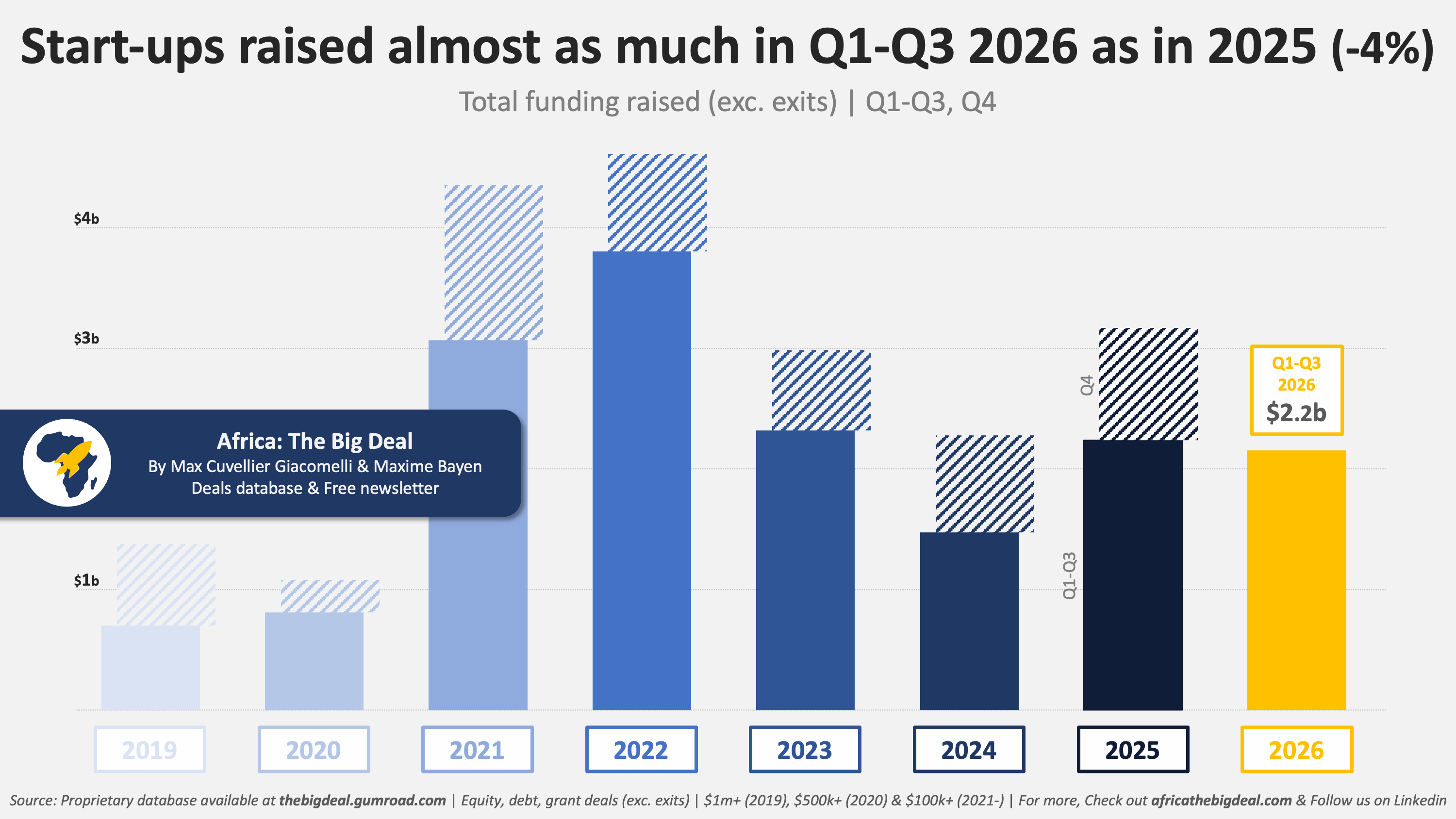
So far, so flat. But look at what type of funding was raised, and the picture changes completely. Indeed, equity funding reached $1.5b in Jan–Sep 2026, +23% YoY. It is actually the best Jan–Sep for equity since 2022, beating 2023 ($1.4b), 2024 ($1b) and 2025 ($1.2b). It is also double what was being raised pre-‘funding heatwave’ ($670m in 2019 and $720m in 2020).
Q3 was actually responsible for a lot of the heavy lifting: $580m of equity were raised over the quarter, 2.5x more than in Q3 2025 ($236m), and the best Q3 for equity since 2021. Yes, a big chunk of it comes from one deal - Moove’s $250m Series C in August - but even without it, Q3 equity would still be up 40% YoY. Jumia ($50m), Yellow Card ($40m), Paymob ($35m), Odyssey Energy Solutions ($27m) and Moment ($22m Series A) all contributed to a very solid quarter.
2️⃣ Debt takes a breather 💸
If equity is up and the total is flat, something had to give, and it was debt. $669m of debt have been raised so far in 2026, -33% YoY compared to Q1-Q3 2025 ($1b). As a share of funding, debt is down to 31%, vs. 45% in the same period last year, 33% in 2024 and 37% in 2023. It is still far above the pre-2023 levels (5% to 16% in 2019-2022), and debt remains a much bigger part of the picture than it used to be.
Regular readers will remember that we’ve been describing the rise of debt as one of the defining trends of the past three years, so this deserves a closer look. We can see two things are going on. First, 2025 was exceptional: d.light ($300m) and Sun King ($156m) alone raised more debt in Q3 2025 than all start-ups combined in Q2 and Q3 2026 ($365m). Second, and this is linked, energy start-ups - historically the biggest debt raisers on the continent - have been much quieter this year with only $93m of debt raised so far vs. $585m in Q1-Q3 2025. The largest debt deals this year - ValU ($64m), Sistema.bio ($53m), Spiro and NALA ($50m each), and Odyssey ($47m) - are smaller and more spread out across sectors.
3️⃣ The longer-term momentum is with equity 📈
Calendar periods can be misleading, so let’s look at 12-month rolling periods, which helps filter out seasonality. Overall, start-up funding stood at $3.1b over the 12 months to September 2026, vs. $3b a year earlier: the total has been fairly stable in the $2.9-3.3b band for over 15 months now, apart from a brief dip in July 2026 ($2.6b).
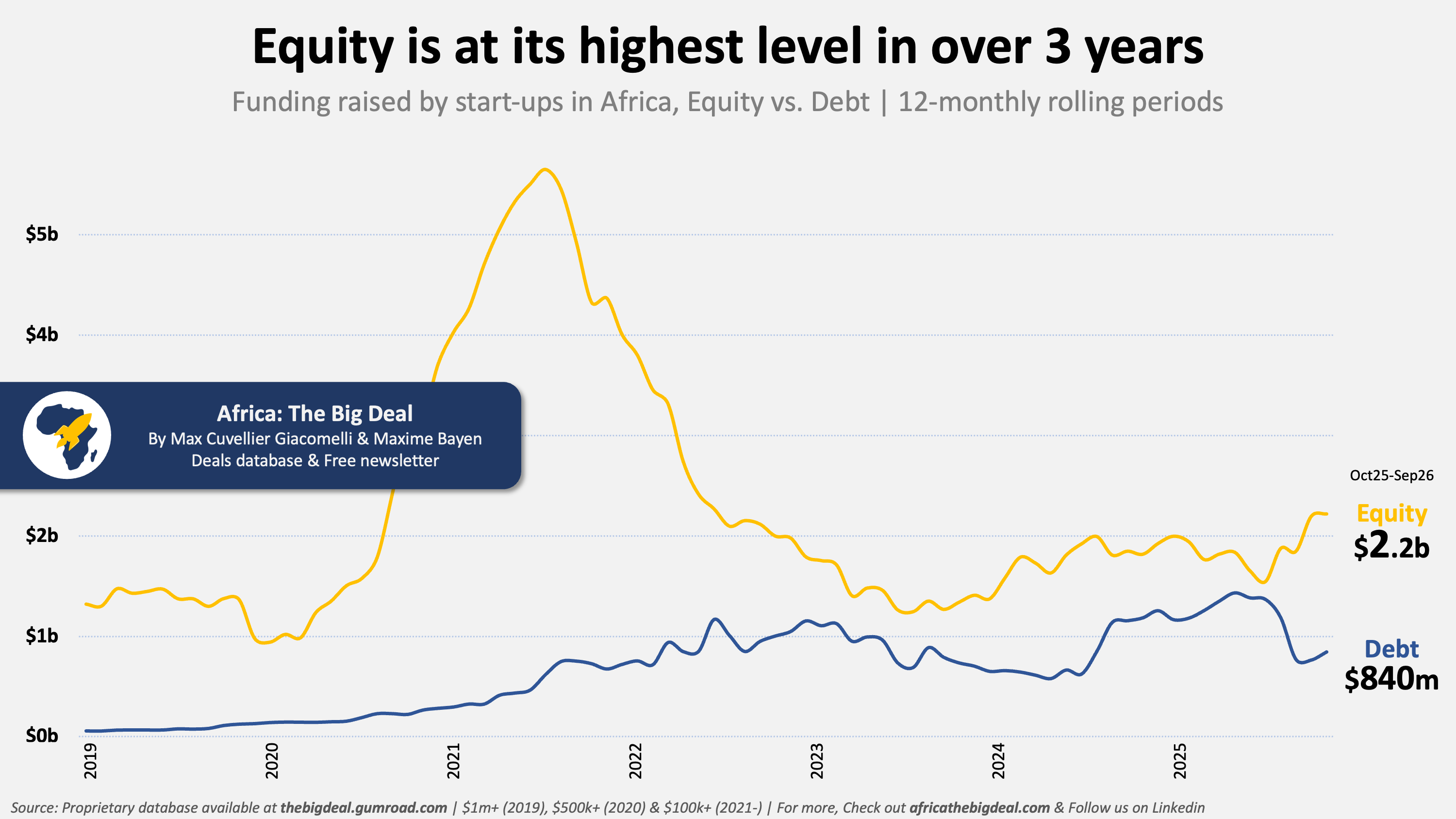
Underneath, though, the equity and the debt lines have recently been moving in opposite directions. Rolling equity funding reached $2.2b at the end of September, up from $1.8b a year earlier and at its highest level in three years. Rolling debt, on the other hand, peaked at a record $1.4b in March 2026 - the highest we’ve ever recorded - before falling back to $840m.
Is the debt trend over? We wouldn’t want anyone to jump to that conclusion just yet: one large (energy) facility in Q4 would be enough to change the picture. But after a long period of stabilisation, this is the clearest sign so far that equity is picking up again. For now, 2026 is an equity year.
So the money is holding up, and equity is making a comeback. The next question is who is getting it, and who is providing it. Our commitment is still not to overload you with information, so we’ll stop here for today and be back soon with takeaways 4 to 6. In the meantime, if you want to dig into the numbers yourself, everything is in our deals database, updated monthly, and at a discount for you lovelies. Bonne journée! Max
Your point that even without Moove's Series C, Q3 equity would still be up 40% is what makes the equity comeback feel real rather than one big headline. As a builder, I wonder whether the shift from debt to equity changes what founders are asked to prove, with less emphasis on predictable repayments and more on growth. Are you seeing that in the kinds of start-ups raising equity now?